How to Remove a News Article From Google Search
Can you remove a news article from Google?
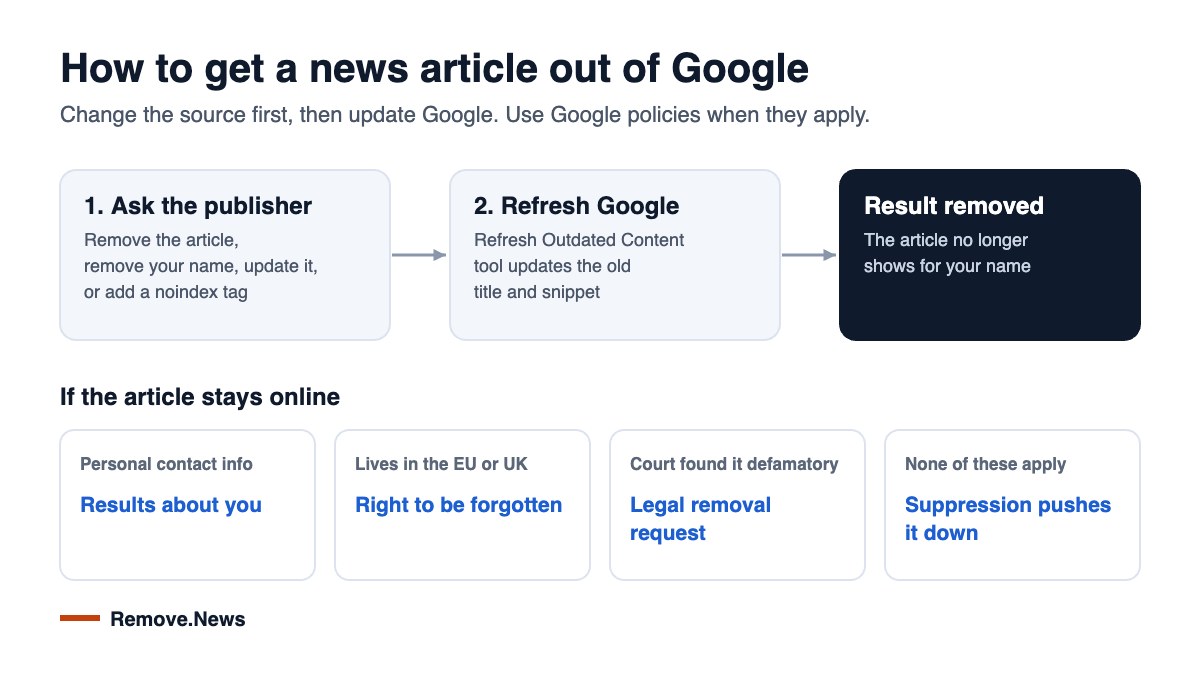
Usually not directly. Google rarely removes a live news article just because you ask. The reliable path is to get the publisher to remove, update or noindex the article, then use Google’s Refresh Outdated Content tool so search results catch up. Google will also remove results in specific cases, such as exposed contact details, EU and UK right to be forgotten requests, or a court order.
- Google shows what the publisher has online, so change the source first.
- Once the page is gone or edited, the Refresh Outdated Content tool updates Google’s result.
- If the article stays up, a few Google policies can still help, and suppression can push it down.
Why won’t Google just remove the article?
Google indexes what is published on the web. It does not judge whether a news story is fair, and it does not delete news articles because they are negative or embarrassing. As long as the page is live and public, it can keep showing up when someone searches your name. That is why every successful removal starts with the publisher, not with Google.
What are your options for getting a news article out of Google?
| Route | When it works | What it removes |
|---|---|---|
| Publisher removal or update | Charges dropped, facts wrong, old story, you were a bystander | The article itself, then the Google result |
| Publisher noindex | The editor will not delete the story but agrees to hide it from search | The Google result, article stays online |
| Refresh Outdated Content tool | The page was deleted or the harmful part was edited out | The outdated Google result or snippet |
| Results about you / personal info policy | The page shows your home address, phone number or email | The Google result for that page |
| Right to be forgotten (EU and UK) | The information is outdated, irrelevant or excessive | Results for your name on European versions of Google |
| Legal removal request | A court has found the article defamatory or unlawful | The Google result |
Step 1: Ask the publisher to remove, update or noindex the article
This is the step that matters most. Editors do take stories down, remove names, or add updates, especially when charges were dismissed, the facts were wrong, the story is many years old, or you were a victim or bystander. Keep your request short, polite and specific, and send it to the newsroom’s corrections or editorial contact rather than the general inbox.
If the editor will not delete the story, ask for one of these instead:
- Remove your name or replace it with initials.
- Add an update with the outcome of your case.
- Add a noindex tag, which keeps the article on their site but tells Google to drop it from search results.
Our free news removal request tool writes the request for you based on your reason, and our publisher guides explain each outlet’s policy.
Write your removal request in under a minute
Paste the article link, choose why it should come down, and get a ready-to-send request. Free, no account.
Step 2: Use Google’s Refresh Outdated Content tool
Once the publisher deletes the article or edits out the harmful part, Google can keep showing the old title and snippet until it recrawls the page. Google’s Refresh Outdated Content tool lets anyone request an update for a page they do not own.
- Sign in to a Google account and open the tool.
- Click New request and paste the exact URL that appears in Google, including http or https and any trailing slash.
- If the page still exists but was edited, enter a word that was removed from the page, such as your name.
- Submit, then check the status in the same tool.
The tool only works when the content has actually changed. Google denies requests when the text you describe is still on the live page, so the publisher has to act first.
What if the article shows your address, phone number or email?
Google will remove search results that expose personal contact details, such as your home address, phone number or email address, under its personal information policy. The easiest way to request this is Google’s Results about you tool, which finds pages showing your contact details and lets you request removal. Google decides case by case, and pages with content of public interest may stay.
Can you use the right to be forgotten for a news article?
If you live in the EU or the UK, you can ask Google to delist results for your name that are inadequate, irrelevant, no longer relevant or excessive. Google reviews each request manually and weighs your privacy against the public’s interest, including your role in public life and how old the story is. News about serious crimes or public figures is often refused. Approved requests remove the result from searches for your name on European versions of Google, not the article itself. See Google’s right to be forgotten overview and our right to be forgotten guide.
In the United States there is no general right to be forgotten, so US residents rely on the publisher, Google’s own policies, and in some cases state privacy laws.
Can a court order remove a news article from Google?
Yes, in limited cases. If a court rules that specific statements in an article are defamatory, Google may remove the result through its legal removal request process. Lawsuits against news outlets are expensive, slow and hard to win, especially in the US where the press has strong protections, so this is usually a last resort. Talk to a media lawyer before you go down this path.
What if the publisher says no?
You still have options:
- Ask for less. An update, a name removal or a noindex tag is easier for an editor to agree to than a deletion.
- Escalate politely. Write to the standards editor or managing editor with documents that support your request.
- Check syndicated copies. Smaller sites that republished the story may remove it even if the original stays.
- Push it down. Positive, accurate pages about you can move the article lower in results. See removal vs suppression.
How long does it take to remove a news article from Google?
Publishers can take anywhere from a few days to several weeks to reply. After the page is changed or deleted, a Refresh Outdated Content request is often processed within days, though timing varies. A right to be forgotten review can take longer because a person reviews each request.
Want us to get it removed? You only pay if it is removed.
We contact the publisher, syndicated copies and Google for you, and confirm the price before any work starts.

Using Refresh Outdated Content, step by step
- Confirm the change is live. Open the article in a private browser window. It should show an error page, a redirect or the edited version without your name.
- Copy the exact URL that appears in Google’s results. If several versions exist (with and without “www”, or with tracking parameters), submit each one that appears in search.
- Open Google’s Refresh Outdated Content tool while signed in to a Google account, and paste the URL.
- Choose the right request type. If the page is gone, Google checks that it returns an error and removes it. If the page was edited, Google asks you for a word that no longer appears on the page, such as your surname, and refreshes the snippet once it confirms the word is gone.
- Track the request. The tool shows the status of each request. Most are processed within a few days.
- Repeat for images. If your photo from the article appears in Google Images, submit the image URL the same way once the image is removed from the page.
If the request is denied, it usually means the page is still live, still contains the word you entered, or still returns content to Google. Check the page again, wait for the publisher’s change to take effect, and resubmit.
Google Search vs. Google News
An article can appear in Google’s main web results, in the Top Stories carousel and in Google News. All of them draw on the same underlying pages, so the same rule applies: once the publisher removes or noindexes the article, it drops out of all of them, and a Refresh Outdated Content request speeds that up. Google News also lets publishers control which of their content appears there, which is one more thing an editor can do if they will not delete the story.
Removing the article from Bing, Yahoo and DuckDuckGo
Bing powers results on several other search engines, including Yahoo and, in part, DuckDuckGo. Bing has its own content removal tool for outdated pages and cached copies, which works much like Google’s. Submit the URL there after the publisher acts. Bing also accepts right to be forgotten requests from people in Europe through its own form.
What Google will remove even if the article stays up
Google generally does not remove live news articles in the United States. But it does remove certain results even when the page itself stays online:
- Personal contact information. Through its Results about you tool, Google can remove results that show your phone number, home address or email address.
- Certain identification and financial details, such as government ID numbers, bank account or card numbers, and images of signatures or ID documents.
- Non-consensual explicit images and certain other sensitive images.
- Doxxing content that shares contact details with an intent to harm.
- Content removed by court order, such as a court finding that specific statements are defamatory.
- Delisting requests in the EU and UK under right to be forgotten rules.
Right to be forgotten: who qualifies
If you live in the European Union, the European Economic Area, Switzerland or the United Kingdom, you can ask Google and Bing to delist results for searches of your name when the information is inaccurate, inadequate, irrelevant or excessive. Search engines weigh your request against the public interest, considering factors such as your role in public life, how old the information is, and whether it relates to a crime. If Google approves the request, the article is delisted from searches for your name on European versions of search, although it stays online. If it is refused, you can complain to your national data protection authority. People outside these regions generally do not have this right, although some countries have their own privacy rules.
What Google will not remove
- A live, accurate news article simply because it is negative or embarrassing.
- An article you think is defamatory, without a court order or other legal basis.
- Results from the publisher’s own site search or archives that you can only reach by browsing.
- Copies of the article on other sites, until those sites remove them too.
Cleaning up autocomplete and “People also ask”
Sometimes the article is gone but its traces linger: an autocomplete suggestion that pairs your name with a word like “arrest”, or a “People also ask” box that repeats the story. These usually fade as the underlying pages disappear and search interest declines. Google lets you report autocomplete predictions that violate its policies, and building accurate results about yourself helps replace them over time.
A quick checklist
- Get the publisher to remove, update, anonymize or noindex the article.
- Submit every version of the URL to Google’s Refresh Outdated Content tool.
- Submit the same URLs to Bing’s content removal tool.
- Remove copies on other sites, then refresh those URLs too.
- Use Results about you for any result showing your contact details.
- If you live in the EU or UK, file a right to be forgotten request for anything that stays up.
- Search your name again in two weeks, in a private window, to confirm.
For the publisher side of the process, see how to remove a news article from the internet and our request letter templates. For timing, see how long removal takes.
Frequently asked questions
Does Google remove negative news articles?
Not because they are negative. Google removes results when the page is gone, when it exposes personal contact details, under EU or UK right to be forgotten rules, or for legal reasons such as a court order.
Can I remove a news article from Google without contacting the publisher?
Only in specific cases, such as exposed contact details or an approved right to be forgotten request. In most cases the publisher has to change or remove the article first.
What is the Refresh Outdated Content tool?
A free Google tool that updates search results for pages that were deleted or edited. It does not remove pages that are still live and unchanged.
Will removing the article from Google remove it from the internet?
No. Removing a Google result hides it in search, but the article stays on the publisher’s site unless the publisher deletes it.
Does it cost money to remove a news article from Google?
Google’s tools are free. Professional help costs money; with Remove.News you only pay if the article is removed. See news article removal cost.
Sources
- Google: Refresh Outdated Content tool
- Google: Find and remove personal info in Google Search results
- Google: Remove personally identifiable info or doxxing content
- Google: Right to be forgotten overview
This guide is general information, not legal advice.